The Public Face of the Ottoman Empire
The Selamlık — from the Arabic selam, meaning "greeting" — was the official, public wing of Dolmabahçe Palace. While the Harem sheltered the private lives of the imperial family, the Selamlık was where the business of empire took place: diplomatic receptions, state council meetings, audiences with foreign ambassadors, and the daily administrative functions of Ottoman governance.
Designed by architects Garabet and Nikogos Balyan and completed in 1856, the Selamlık occupies the entire southern wing of the palace. Its rooms are deliberately grander, more formal, and more European in style than those of the Harem — this was, after all, the face that the Ottoman Empire presented to the world.
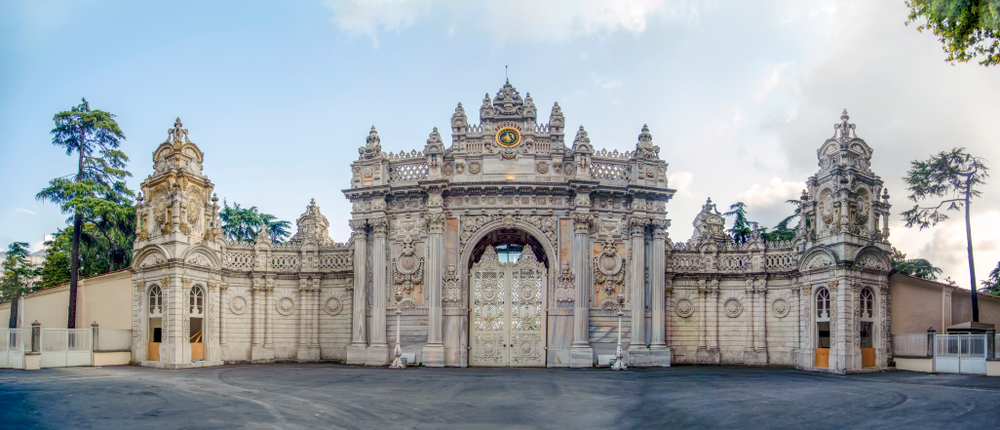
The Medhal Hall: First Impressions
The Medhal Hall is the formal entrance to the Selamlık, and it was designed to overwhelm. The moment a visitor stepped through the doors, they were confronted with the full force of Ottoman wealth and sophistication.
Architectural Details
The Medhal Hall features:
- Soaring ceilings painted with allegorical scenes in the European academic tradition
- Massive crystal chandeliers from Baccarat, Paris — among the first to be installed in the palace
- Hereke carpets covering the marble floors, each one woven in the imperial workshops
- Gilded cornices and moldings in a mix of Baroque and Neoclassical styles
- Bear-skin rugs — gifts from the Tsar of Russia — flanking the ceremonial staircase
The Medhal served as a waiting area where visitors would be received by palace officials before being escorted deeper into the Selamlık. The protocol was precise: the rank of the visitor determined how far into the palace they would be allowed to proceed. A minor diplomat might only see the Medhal. An ambassador would be taken all the way to the Sufera Hall.
The Crystal Staircase
Connecting the Medhal to the upper floors is the famous Crystal Staircase, with its double horseshoe design and balustrades made of Baccarat crystal and brass. The staircase was engineered so that visitors ascending to the upper rooms would be visible from below — a calculated theatrical effect that amplified the grandeur of arrival.
The Ambassador's Chamber (Sefir Odası)
Beyond the Medhal, the Ambassador's Chamber was where Ottoman foreign policy came to life. This was the room where individual foreign envoys were received for private audiences with the Grand Vizier or, on special occasions, the Sultan himself.
Design and Symbolism
The chamber is decorated with:
- French-inspired ceiling frescoes depicting scenes of abundance and prosperity
- Venetian mirrors lining the walls, creating an illusion of infinite depth
- Gilded furniture upholstered in crimson silk, commissioned from Parisian workshops
- Porcelain vases from Sèvres and Yıldız, placed symmetrically in wall niches
Every element was chosen to communicate a message: the Ottoman Empire was modern, wealthy, and the equal of any European power. The Ambassador's Chamber was not just a room — it was a diplomatic statement.
Diplomatic Functions
In this room, ambassadors would present their credentials, negotiate trade agreements, and discuss matters of war and peace. The Ottoman foreign ministry maintained strict protocols for these audiences, including the specific chair where each ambassador would sit (positioned slightly lower than the Ottoman official's seat, naturally).
The Red Room (Kırmızı Oda)
The Red Room is one of the most visually striking spaces in the Selamlık. As its name suggests, the room is dominated by a deep crimson color scheme — red silk wall coverings, red velvet upholstery, red-toned Hereke carpets, and red-framed mirrors.
Purpose and Atmosphere
The Red Room served as a formal reception salon for high-ranking officials and visiting dignitaries. Its intense color was deliberate: red symbolized power, sovereignty, and the imperial presence. In Ottoman court culture, the color red was closely associated with the Sultan's authority.
Notable Features
- A massive Bohemian crystal chandelier weighing over 1.5 tons
- Ceiling paintings by French and Italian artists commissioned by Sultan Abdülmecid
- Hand-carved wooden panels covered in gold leaf
- A fireplace with an ornate marble surround, more decorative than functional in Istanbul's mild climate
- Writing desks inlaid with mother-of-pearl and tortoiseshell
The room's acoustics were designed to carry conversation clearly — essential for a space used for political discussions. The thick silk wall coverings absorbed echo while the hard marble floor reflected sound at ear level.
The Blue Hall (Mavi Salon)
In dramatic contrast to the Red Room, the Blue Hall is awash in cool blues and silver tones. This was one of the most important reception rooms in the Selamlık, used for larger gatherings and formal receptions.
Design Philosophy
The Blue Hall represents the pinnacle of the European influence on Ottoman interior design:
- Ceiling frescoes painted in the Rococo style, depicting clouds, cherubs, and classical allegories
- Blue silk damask covering the walls from floor to ceiling
- Silver-gilt furniture arranged in the European salon style
- Crystal chandeliers with blue-tinted glass pendants that cast a cool, ethereal light
- Enormous Venetian mirrors reflecting the Bosphorus light from the windows
A Room for Music and Ceremony
The Blue Hall was frequently used for musical performances. Ottoman court musicians and visiting European performers would play here for the Sultan and his guests. The room's proportions were calculated to provide excellent acoustics for both Ottoman classical music (with its quarter-tone subtleties) and European orchestral pieces.
The Vizier Chamber
The Grand Vizier — the Sultan's chief minister and the head of the Ottoman government — had his own dedicated chamber within the Selamlık. This room functioned as a combination office and audience chamber where the Vizier conducted daily government business.
Administrative Heart
The Vizier Chamber was less ornate than the diplomatic reception rooms, but no less important. Here, the day-to-day decisions that kept the empire running were made:
- Provincial governors' reports were reviewed
- Military dispatches were received and answered
- Tax revenues were tallied and budgets approved
- Judicial appeals from across the empire were heard
The room contains the Vizier's original desk, a substantial piece of European-made furniture with hidden compartments and locking drawers — essential for storing sensitive state documents.
The Sufera Hall (Ambassadors' Hall)
The Sufera Hall is the grand finale of the Selamlık tour and one of the most magnificent rooms in the palace. "Sufera" is the Ottoman Turkish word for "ambassadors," and this hall was designed specifically for the most important diplomatic ceremonies of the empire.
Architecture
The Sufera Hall is a vast rectangular room with:
- A ceiling height of over 12 meters, painted with elaborate allegorical scenes
- 16 massive columns with gilded Corinthian capitals
- Four enormous crystal chandeliers, each weighing several tons
- A balcony level from which musicians would perform during ceremonies
- Floor-to-ceiling windows on the Bosphorus side, flooding the room with light
Ceremonies and Protocol
The most important ceremony held in the Sufera Hall was the Bayram reception, when foreign ambassadors would formally congratulate the Sultan on Islamic holidays. The ambassadors would enter in strict order of protocol (based on the length of time their country had maintained diplomatic relations with the Ottoman Empire), approach the Sultan's throne, and offer their congratulations through an interpreter.
This ceremony was one of the grandest events in the Ottoman diplomatic calendar, and the Sufera Hall was designed to make it as spectacular as possible.
The European Art Collection
The Selamlık houses a significant portion of the palace's European art collection. Paintings by prominent 19th-century European and Ottoman artists line the walls of the major reception rooms:
- Works by Ivan Aivazovsky, the Russian-Armenian marine painter who was a favorite of Sultan Abdülaziz
- Landscape paintings commissioned from European academicians
- Portraits of Ottoman sultans in European court dress
- Orientalist works purchased during diplomatic missions to Paris and London
The collection reflects the cultural ambitions of the late Ottoman period — a conscious effort to demonstrate that Istanbul was as much a capital of the arts as Paris, Vienna, or London.
The Selamlık Experience
What to Expect on Your Visit
Visiting the Selamlık is a guided experience. You will be escorted through the rooms in a set sequence, with the guide providing commentary in Turkish and English. Photography is not permitted inside.
Practical Tips
- Arrive early: The Selamlık tour starts at 9:00 AM and the first groups are the smallest
- Wear shoe covers: Provided at the entrance to protect the Hereke carpets
- Listen carefully: The guide's explanations add enormous context to rooms that might otherwise appear as "just another fancy room"
- Look up: The ceilings are among the most impressive features, and many visitors miss them
- Note the floors: The intricate parquet patterns are works of art in themselves
Connecting to Other Sections
The Selamlık connects to the Ceremonial Hall (Muayede Salonu), which sits at the center of the palace between the Selamlık and the Harem. After completing the Selamlık tour, you can visit the Ceremonial Hall to see the legendary 4.5-ton Baccarat chandelier, and then proceed to the Harem section.
Legacy
The Selamlık of Dolmabahçe is more than a collection of beautiful rooms. It is a physical record of the Ottoman Empire's final century — its ambitions, its anxieties, and its determination to be recognized as a modern European power. Every gilded cornice, every crystal chandelier, every Hereke carpet tells the same story: the Ottomans were here, they were powerful, and they built something extraordinary.
Today, the Selamlık receives hundreds of thousands of visitors each year, each one walking the same halls where ambassadors once negotiated the fate of nations. The rooms are preserved exactly as they were in the 19th century, a frozen moment of Ottoman grandeur that continues to inspire awe.