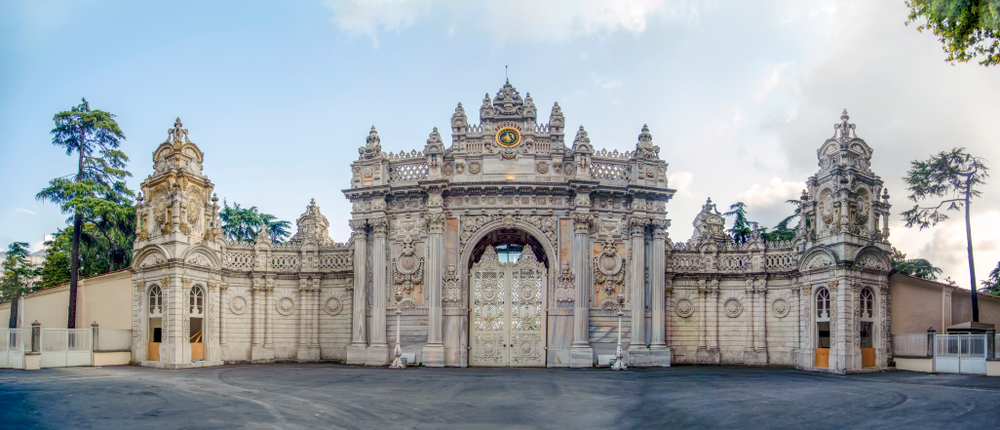
25 Things You Probably Did Not Know About Dolmabahçe Palace
Construction and Cost
1. It cost 25% of the empire's annual revenue. The construction of Dolmabahçe Palace cost approximately 5 million Ottoman gold liras — equivalent to about 35 tonnes of gold. This was roughly one-quarter of the Ottoman Empire's total annual tax revenue.
2. The site was literally "filled in." The name "Dolmabahçe" means "filled garden." The palace stands on a former bay of the Bosphorus that was filled with earth starting in the 1600s. The entire building sits on reclaimed land.
3. It took 13 years to build. Construction began in 1843 and was completed in 1856 — longer than many European palaces of comparable size.
4. Father and son designed it. The palace was designed by Garabet Amira Balyan and his son Nigoğayos Balyan, Armenian-Ottoman architects. Nigoğayos had studied at the Paris Académie des Beaux-Arts.
The Numbers
5. 285 rooms, 46 halls, 68 toilets. The palace is Turkey's largest, with more rooms than most European palaces. The 68 toilets were considered extraordinarily modern for the 1850s.
6. 14 tonnes of gold leaf. The interior decoration consumed an estimated 14,000 kilograms of gold leaf — more than any other palace in Turkey. The gold covers ceilings, cornices, mirror frames, and furniture.
7. 40 tonnes of silver. Silver was used extensively for furniture, candelabras, service items, and decorative elements throughout the palace.
8. 36 chandeliers. Every major room in the palace has at least one chandelier, totaling 36 throughout the building. The largest, in the Ceremonial Hall, weighs 4.5 tonnes.
9. 600-meter waterfront facade. The Bosphorus-facing facade stretches over half a kilometer — one of the longest palace facades in Europe.
The Ceremonial Hall
10. The chandelier weighs 4.5 tonnes. The Bohemian crystal chandelier in the Ceremonial Hall is the largest of its kind in the world, with 750 lights and thousands of individual crystal pieces.
11. The dome is 36 meters high. The Ceremonial Hall's dome would be one of the tallest rooms in any building of its era. It is taller than many church domes in Europe.
12. The carpet was woven for the room. The enormous Hereke carpet covering the Ceremonial Hall floor was custom-designed and woven specifically for this single room at the imperial carpet workshop.
The Sultans
13. Six sultans lived here. From 1856 to 1922, six different sultans called Dolmabahçe home: Abdülmecid I, Abdülaziz, Murad V, Abdülhamid II, Mehmed V, and Mehmed VI.
14. One sultan fled by warship. The last sultan, Mehmed VI, escaped Istanbul on November 17, 1922, aboard the British warship HMS Malaya. He left through the back gate of Dolmabahçe under cover of darkness, ending 469 years of Ottoman rule.
15. One sultan reigned for only 93 days. Murad V, who lived briefly at Dolmabahçe, was sultan for just 93 days before being deposed for mental instability in 1876.
16. One sultan was too paranoid to stay. Abdülhamid II moved out of Dolmabahçe in 1880, finding its exposed Bosphorus location a security risk. He retreated to the hilltop Yıldız Palace.
Atatürk
17. Every clock is stopped at 09:05. When Atatürk died at 09:05 on November 10, 1938, every clock in the palace was stopped at that time. They have remained frozen for over 85 years.
18. His bed is draped with the Turkish flag. Room 71, where Atatürk died, is preserved exactly as it was. The bed is covered with the Turkish national flag — red with a white crescent and star.
19. 300,000+ visitors on November 10. Each year on the anniversary of Atatürk's death, hundreds of thousands of people queue to pass through Room 71, making it one of the largest acts of collective memory anywhere in the world.
Art and Craft
20. Aivazovsky painted for the palace. Ivan Aivazovsky, the famous Russian-Armenian marine painter, was a favorite of Sultan Abdülaziz. Several of his Bosphorus and naval paintings hang in the palace.
21. The Crystal Staircase uses Baccarat crystal. The iconic staircase's balusters are made of genuine Baccarat crystal, hand-cast in France.
22. The baths are made of Egyptian alabaster. The imperial hamams (baths) in both the Selamlık and Harem sections are lined with translucent Egyptian alabaster — a rare and expensive material.
Modern Firsts
23. It had central heating in the 1850s. Dolmabahçe was one of the first buildings in Istanbul with a central heating system, using underground furnaces and channels to distribute warmth.
24. Gas lighting before electricity. The palace was fitted with gas lighting when it was built, making it one of the most technologically advanced buildings in the Ottoman Empire. It was later converted to electricity.
25. 2.5 million visitors per year. Today, Dolmabahçe Palace receives approximately 2.5 million visitors annually, making it one of the most visited sites in Istanbul and one of the most popular palaces in Europe.