A Palace Between Two Worlds
Dolmabahçe Palace is not purely European, nor is it purely Ottoman. It is something rarer and more interesting: a conscious, deliberate hybrid. When Sultan Abdülmecid I commissioned the Balyan family to design a new imperial residence in 1843, the brief was clear but contradictory — build a palace that would impress European visitors with its modernity while still feeling Ottoman in its bones.
The result is a 45,000-square-meter building that borrows freely from French Baroque, Italian Rococo, and English Neoclassical traditions, while organizing its spaces around the Ottoman distinction between selamlık (public/ceremonial) and harem (private/domestic). From the outside, it could be mistaken for a palace on the Seine. On the inside, the fusion becomes unmistakable.
The Balyan Family: East-West Architects
The Balyan family were Armenian-Ottoman architects who served the sultans across four generations. For Dolmabahçe, the key figures were:
Garabet Amira Balyan (1800–1866) led the overall design and construction. A master of traditional Ottoman building techniques, Garabet also had a deep understanding of European styles through study and travel.
Nigoğayos Balyan (1826–1858), Garabet's son, brought the European dimension. Having studied at the Académie des Beaux-Arts in Paris — one of Europe's premier architecture schools — Nigoğayos was steeped in Beaux-Arts classicism, French Baroque symmetry, and the monumental grandeur that defined European palace design.
Together, father and son created an architecture that neither could have achieved alone. Garabet's Ottoman pragmatism grounded the palace in its cultural context; Nigoğayos's European training gave it the visual language of Western power.
The Floor Plan: Tripartite Organization
Dolmabahçe's floor plan follows a strict tripartite organization running along the Bosphorus shore:
1. Selamlık (Mabeyn-i Hümayun) — Southern Wing
The public and ceremonial wing where the Sultan conducted state affairs. This section faces both the main approach road (Dolmabahçe Caddesi) and the Bosphorus waterfront. Key spaces include:
- Medhal Hall — The grand entrance with elaborate ceiling frescoes by French and Italian artists
- Crystal Staircase — The iconic double-horseshoe staircase with Baccarat crystal balusters
- Red Room — Where foreign ambassadors were formally received
- Süfera Hall — The ambassadors' waiting room, with Hereke silk carpets and European oil paintings
- Zülvecheyn Hall — The "two-faced" hall opening onto both the garden and the sea
2. Muayede Salonu — Central Hall
The Ceremonial Hall is the monumental pivot point between the public and private wings. At 2,000 square meters with a 36-meter-high dome, it is the largest ceremonial room in any Turkish palace — and one of the largest in Europe. The 4.5-ton Bohemian crystal chandelier dominates the space.
3. Harem-i Hümayun — Northern Wing
The private quarters for the imperial family. Organized into eight distinct apartment suites:
- Valide Sultan (Queen Mother) — The most luxurious private apartments
- Sultan's quarters — Personal rooms and private study
- Consorts' apartments — Separate suites for each wife
- Princes' and princesses' wings — Dedicated quarters for royal children
- Service areas — Kitchens, hamams, and staff quarters
Exterior Architecture
The Bosphorus Facade
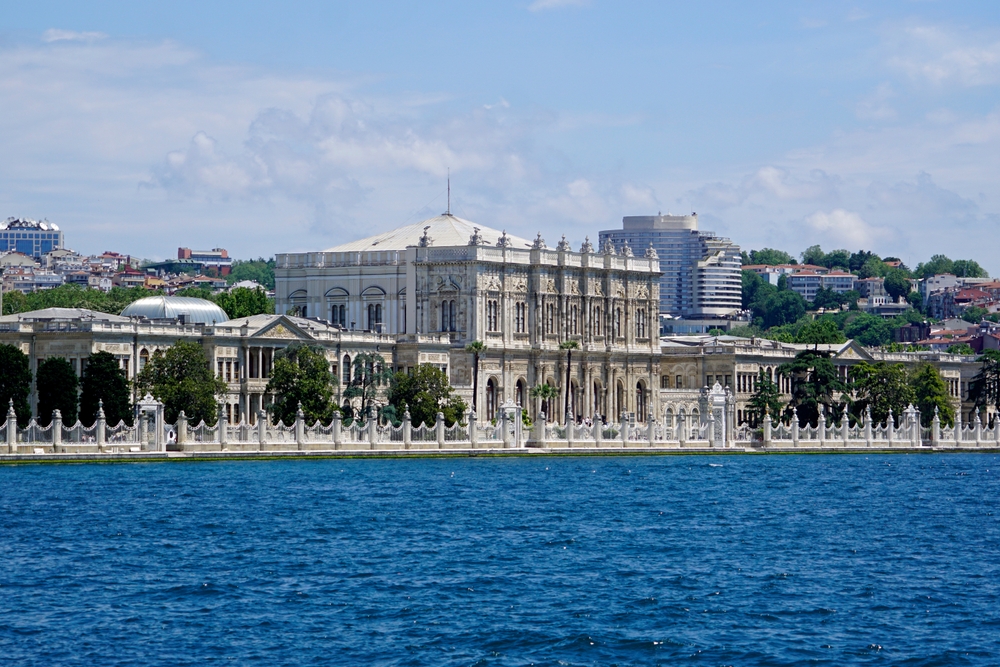
The palace's most impressive face is its 600-meter waterfront facade, visible from ferries crossing the Bosphorus. The facade is clad entirely in white Marmara marble and organized with:
- Symmetrical bays with projecting central and corner pavilions
- Corinthian columns and pilasters at the ground and upper levels
- Baroque cartouches and pediments framing windows
- Ottoman-style arched windows on the ground floor
- Balustrade parapets along the roofline
- Rococo ornamental details including shell motifs, scrollwork, and garlands
The facade is monochromatic — all white marble — which gives it a severity and grandeur quite different from the polychrome surfaces of traditional Ottoman architecture.
The Imperial Gates
Two monumental gates provide access to the palace grounds:
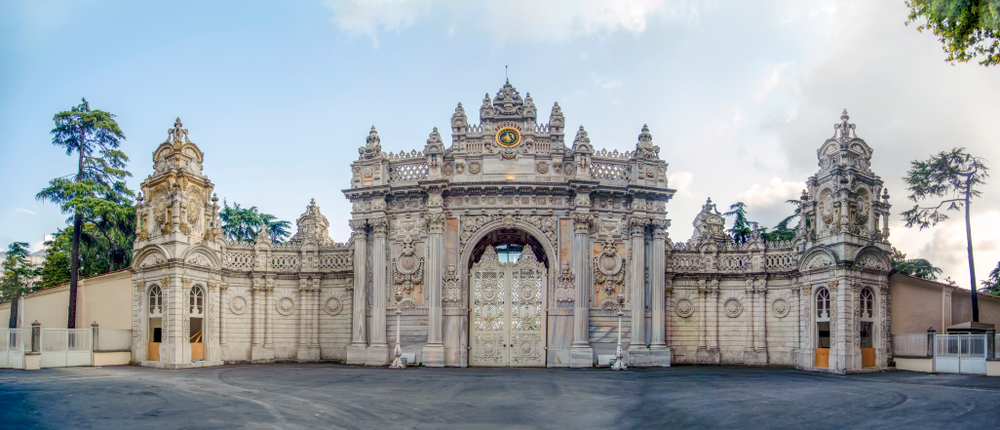
- Treasury Gate (Hazine Kapısı) — The main ceremonial entrance from Dolmabahçe Caddesi, featuring elaborate Baroque stonework, imperial tuğra (calligraphic monogram), and gilded ironwork
- Saltanat (Imperial) Gate — The waterfront gate facing the Bosphorus, used for ceremonial arrivals by boat
Interior Design: 14 Tons of Gold
The interior of Dolmabahçe is where the East-West fusion becomes most dramatic. The decorative program consumed:
- 14 tonnes of gold leaf — Applied to ceilings, cornices, door frames, furniture, and mirror frames
- 40 tonnes of silver — Used in furnishings, candelabras, and decorative elements
- 202 original oil paintings — A mix of European and Ottoman artists, including Ivan Aivazovsky
- Hereke carpets — Custom-designed and woven at the imperial Hereke carpet factory
- Baccarat crystal — For the Crystal Staircase balusters and table settings
- Bohemian crystal — For the 36 chandeliers throughout the palace
- Egyptian alabaster — For the imperial hamams (baths)
- French silk — From Lyon, for curtains and upholstery
Ceiling Art
The ceilings are arguably the most stunning feature. Italian-born painter Charles Séchan (who also worked on the Paris Opera) supervised many of the trompe l'oeil ceiling compositions. The Medhal Hall ceiling features allegorical figures representing the arts and sciences. Other ceilings combine Ottoman arabesque patterns with European figurative painting — a combination unique to Dolmabahçe.
Flooring
Most floors feature parquet woodwork in intricate geometric patterns, overlaid with enormous Hereke carpets. The Ceremonial Hall floor is particularly notable for its massive single-piece Hereke carpet, weighing several tonnes and woven specifically for the room.
Heating and Modern Systems
Dolmabahçe was one of the most technologically advanced buildings of its era:
- Central heating via underground furnaces and channels — a first for any Ottoman building
- Gas lighting (later converted to electricity) — installed in the 1850s
- Indoor plumbing — with hot and cold running water to all major rooms
- Flush toilets — 68 across the palace, a remarkable number for the era
Architectural Comparisons
Dolmabahçe vs. Topkapı Palace
| Feature | Dolmabahçe | Topkapı |
|---|---|---|
| Style | European Eclectic | Classical Ottoman |
| Layout | Single monumental building | Pavilion complex with courtyards |
| Facade | 600m marble waterfront | Walls and gates, no monumental facade |
| Construction | 1843–1856 | 1459–1465 (expanded over centuries) |
| Rooms | 285 | ~400 (across multiple buildings) |
| Orientation | Outward (Bosphorus) | Inward (courtyards) |
Dolmabahçe vs. Versailles
| Feature | Dolmabahçe | Versailles |
|---|---|---|
| Style | Baroque-Rococo-Ottoman | French Baroque-Classicism |
| Size | 45,000 m² | 63,000 m² |
| Rooms | 285 | 700+ |
| Cost (relative) | 25% of annual state revenue | ~50% of France's annual revenue |
| Waterfront | Yes (Bosphorus) | No (gardens) |
| Hybrid elements | Ottoman-European fusion | Purely French |
The Crystal Staircase
The most photographed architectural element in the palace is the Crystal Staircase (Kristal Merdiven). Designed by Nigoğayos Balyan, it features:
- Baccarat crystal balusters — Each one hand-cast in France
- Double-horseshoe design — A wide, swooping shape that creates a dramatic sense of ascent
- Brass railings — Polished to a mirror finish
- Marble steps — Wide and shallow for ceremonial processions
The staircase connects the ground floor to the upper ceremonial rooms and was designed to ensure that foreign dignitaries would be impressed before they even reached the reception halls.
Materials: Where East Meets West
The sourcing of materials tells the story of Dolmabahçe's global ambitions:
| Material | Source | Used For |
|---|---|---|
| Marmara marble | Turkey | Exterior facade |
| Egyptian alabaster | Egypt | Hamams (baths) |
| Baccarat crystal | France | Crystal Staircase |
| Bohemian crystal | Czech lands | Chandeliers |
| Gold leaf | Europe | Interior decoration |
| Hereke silk/wool | Turkey | Carpets and curtains |
| Lyon silk | France | Curtains and upholstery |
| Porphyry | Egypt | Decorative columns |
| Rosewood | Brazil | Parquet flooring |
This diversity of materials was itself a statement. Dolmabahçe Palace drew from across the Ottoman trade network and European markets, creating a genuinely international building in an age when architecture was becoming increasingly nationalistic.
Legacy and Influence
Dolmabahçe set the template for late Ottoman imperial architecture. After its completion, several other palaces and pavilions were built in similar styles:
- Beylerbeyi Palace (1865) — On the Asian shore, smaller but similarly European-influenced
- Çırağan Palace (1871) — Adjacent to Dolmabahçe, now a luxury hotel
- Küçüksu Pavilion (1857) — A hunting lodge on the Asian shore
- Yıldız Palace (1880s) — Abdülhamid II's alternative residence
None matched Dolmabahçe's scale or ambition. The palace remains the defining statement of Ottoman Eclecticism — a style born from the tension between an ancient empire and a modernizing world.